
How to Organize a Digital Catalog for High-Volume Kanchipuram and Kurti Inventories: E-Commerce Basics
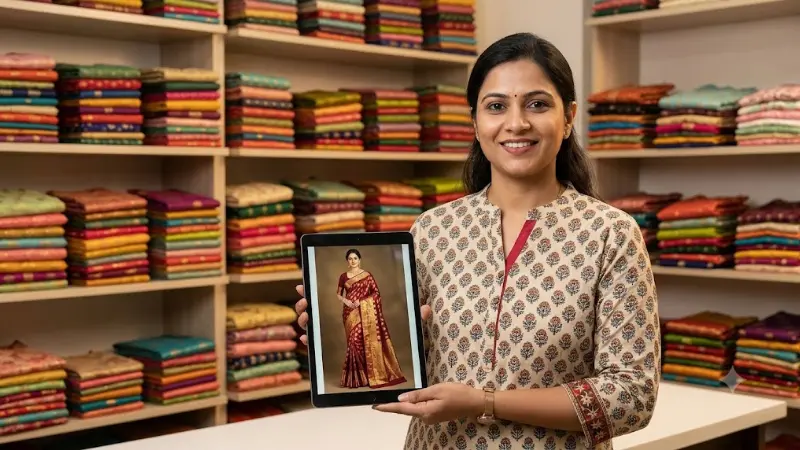
How to Organize a Digital Catalog for High-Volume Kanchipuram and Kurti Inventories: E-Commerce Basics
For Indian e-commerce sellers specializing in ethnic wear, managing a high-volume inventory is both a blessing and a challenge. A diverse collection of intricate Kanchipuram sarees, varied Kurtis, gowns, and other apparel (the Easyfit AI database alone supports over 300 types of Indian dresses!) can attract a wide customer base.
However, without a structured digital catalog, your customers will get lost in an endless sea of products, leading to high bounce rates and abandoned carts.
A successful digital catalog is about more than just listing items; it's about making them discoverable, desirable, and easy to buy. Here is a fundamental guide to organizing your large-scale ethnic wear inventory effectively.
1. Implement a Robust SKU Architecture
Before you upload a single image, you need a backend system that can handle complexity. In a high-volume setting, manual tracking is impossible. You require a robust product management system that supports infinite variants.
- Parent-Child Relationships: Treat the base design of a Kanchipuram saree as the 'parent' product. Each available color (e.g., Maroon, Electric Blue, Emerald Green) should be a 'child' variant.
- Logical SKU Creation: Your Stock Keeping Units (SKUs) should tell you exactly what the item is.
- Example (Kanchipuram):
KAN-MAR-ZARI-001(Kanchipuram - Maroon - Gold Zari - Design #001) - Example (Kurti):
KUR-CTN-SM-PRT-102(Kurti - Cotton - Size Small - Printed - Design #102)
- Example (Kanchipuram):
This level of detail, manageable via dashboards like the Easyfit AI accounts-nextjs console, is critical for accurate inventory tracking, analytics, and order fulfillment.
2. Dynamic Categories and Taxonomies
A simple "Saree" category won’t suffice when you have thousands of SKUs. Implement multi-level categorization and powerful filtering to help customers drill down quickly.
Suggested Hierarchy for Indian Ethnic Wear:
- Primary Category: Saree
- Secondary Category (Sub-category): Silk
- Tertiary Category (Attribute): Kanchipuram
- Filters: Color (Red, Blue, Gold), Border Type (Temple, Checked, Plain), Occasion (Bridal, Festive, Party), Zari Type (Pure, Tested).
- Tertiary Category (Attribute): Kanchipuram
- Secondary Category (Sub-category): Silk
- Primary Category: Kurti
- Secondary Category (Length): Long (Ankle)
- Tertiary Category (Fabric): Cotton
- Filters: Size (S, M, L, XL), Color, Print (Ajrakh, Ikat, Block), Neck Design.
- Tertiary Category (Fabric): Cotton
- Secondary Category (Length): Long (Ankle)
By structuring your catalog this way on your Next.js storefront, you ensure that even a customer with highly specific tastes can find their perfect match within seconds.
3. SEO-Driven Metadata and Rich Product Descriptions
Your product titles and descriptions are your online sales assistants. They must serve two masters: the search engine algorithm and the human shopper.
- Titles: Be specific. Instead of "Blue Saree," use "Handloom Kanchipuram Silk Saree in Cobalt Blue with Gold Zari Border."
- Descriptions: Describe the fabric texture, the weight, the type of weave, the historical context of the pattern, and care instructions. This builds trust.
- Metadata: Ensure your e-commerce platform generates dynamic metadata and structured data (JSON-LD) for every product. This is essential for ranking on Google when users search for items like "bridal Kanchipuram silk saree online." Platforms like Easyfit AI automatically optimize storefronts with dynamic metadata to maximize SEO.
4. Solving the Product Photography Bottleneck: Enter AI
This is the biggest hurdle for high-volume ethnic wear sellers. Organizing thousands of items is one thing; getting thousands of professional model photoshoots is another. Traditional photography is slow, expensive, and a logistical nightmare for every color variant of every Kurti.
This is where the paradigm shifts. The "E-Commerce Basic" of today is no longer "schedule a model photoshoot"; it is "leverage AI generation."
Modern platforms, like the Easyfit AI virtual trial room, eliminate the need for manual photoshoots. You can upload a photo of your Kanchipuram saree (a simple "flat lay" or garment shot) and a photo of a person. The advanced AI (utilizing models like Google’s Gemini) generates a realistic image of that person wearing the garment.
How AI Streamlines Catalog Organization:
- Speed to Market: Generate model shots for 100 new Kurti designs in minutes, not weeks.
- Variant Coverage: Instead of just showcasing the red version of a saree, you can use AI to generate model images for the green, blue, and yellow variants instantly, providing visual completeness for every product page.
- Lower Overheads: Drastically reduce the cost per SKU, enabling you to list larger inventories profitably.
- "My Face in Model Body": The advanced technology even allows customers to seamlessly place their face onto the model's body in your catalog image, perfectly matching skin tone and lighting for the ultimate personalized shopping experience.
Conclusion
Organizing a high-volume Kanchipuram and Kurti inventory is a complex endeavor that requires both logistical discipline and technological adoption. By implementing robust SKU architecture, logical taxonomies, detailed SEO-driven content, and utilizing cutting-edge AI virtual trial room technology to solve your photography bottleneck, you can transform your massive inventory from a management challenge into a potent sales engine.
Ready to take action?
Start implementing the exact methods outlined in this guide.
Boost My Store with AI Trial Room – Only ₹599/month