
Understanding E-Commerce Shipping Zones and Tiered Pricing in India Logistics & RTO
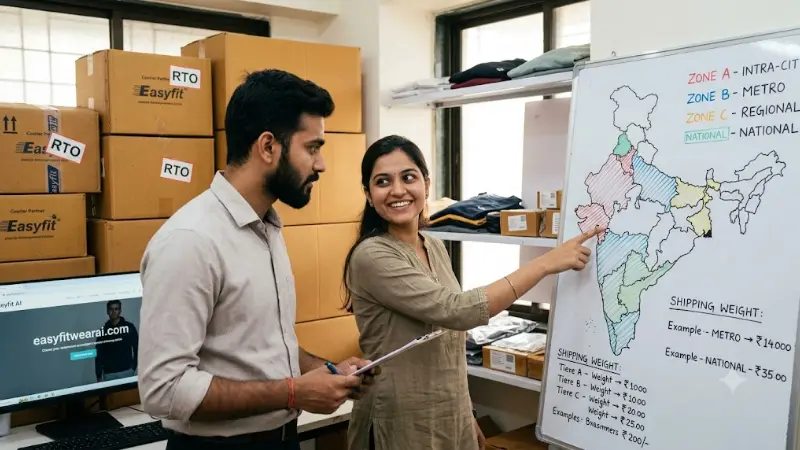
Navigating the logistics landscape in India is one of the most significant challenges for e-commerce sellers. Unlike smaller geographic markets, India’s vastness necessitates a complex system of shipping zones and tiered pricing. Furthermore, the high prevalence of Cash on Delivery (COD) introduces a unique obstacle: Return to Origin (RTO).
For sellers on platforms like Easyfit AI, understanding these logistics dynamics is crucial for maintaining profitability while offering competitive pricing to customers across the subcontinent. This guide breaks down the essential components of Indian e-commerce logistics and offers strategies to manage costs effectively.
1. Demystifying Shipping Zones in India
Logistics providers in India generally categorize shipments into specific zones based on the distance between the pickup point (seller’s warehouse) and the delivery point (customer’s address). Understanding these zones is the first step in determining your shipping costs.
While specific definitions may vary slightly by courier (like Shiprocket, Delhivery, or Blue Dart), the standard zonal structure includes:
- Intra-City (Zone A): Pickup and delivery happen within the same city. This is usually the fastest and cheapest shipping option.
- Intra-State / Metro-to-Metro (Zone B): This includes shipments within the same state (excluding Intra-City) or shipments between major metro cities (e.g., Delhi to Mumbai, Bangalore to Chennai).
- Rest of India (RoI) / Metro-to-Non-Metro (Zone C): This covers shipments from a metro city to a non-metro city, or between different states that are not adjacent.
- Special Zones (Zone D & E): These typically apply to regions that are geographically challenging or remote, such as the North East states, Jammu & Kashmir, and island territories (Andaman & Nicobar, Lakshadweep). Shipping to these zones is invariably the most expensive.
Why Zones Matter: Your product pricing strategy must account for these varying costs. Selling a ₹999 kurthi with free shipping might be profitable for Zone A, but could result in a loss if the customer is in Zone D.
2. Understanding Tiered Pricing
Logistics companies do not offer a flat rate for all shipments within a zone. Instead, they utilize a Tiered Pricing model based on weight and dimensions.
Dead Weight vs. Volumetric Weight
Couriers charge based on which is higher: the actual weight (dead weight) or the volumetric weight.
- Volumetric Weight Calculation: (Length x Width x Height in cm) / 5000 (standard divisor, though some couriers use 4000 or 4500).
If you are shipping a voluminous item like a heavy bridal gown, the volumetric weight will likely exceed the dead weight, resulting in higher charges.
Price Tiers (Slabs)
Pricing is structured in weight slabs, most commonly starting at 500 grams (0.5 kg).
- Standard Tiers: 0-0.5 kg, 0.5-1 kg, 1-2 kg, 2-5 kg, etc.
- Additional Charges: If a package exceeds a slab (e.g., weighs 0.51 kg), it is automatically billed at the next higher slab (1 kg).
Sellers must optimize packaging to fit within the lower weight slabs whenever possible to save on shipping costs.
3. The RTO Challenge in Indian E-Commerce
Return to Origin (RTO) occurs when a shipment cannot be delivered and is returned to the seller. This is a major drain on revenue because:
- You pay for forward shipping.
- You pay for return shipping (often the same amount or slightly discounted).
- Your inventory is blocked during the transit period.
- There is a risk of product damage during transit.
The COD Connection
In India, COD remains a preferred payment method. However, COD orders have a significantly higher RTO rate compared to prepaid orders. Common reasons include:
- Customer unavailability.
- Incorrect address.
- Customer refused delivery (changed mind or found a better deal).
- Impulse buying (common with clothing).
4. Strategies to Manage Logistics and Reduce RTO
To optimize your supply chain and protect your margins, consider these strategies:
A. Dynamic Shipping Charges
Instead of offering "Free Shipping" across India, integrate dynamic shipping calculations at checkout. Use an API (like Shiprocket's) to calculate the exact shipping cost based on the customer’s pin code and charge accordingly, or offer free shipping only for orders above a certain value or within certain zones.
B. Courier Allocation Engine
Use a logistics aggregator that allows you to automatically assign couriers based on the lowest cost or fastest delivery time for a specific zone. For example, Courier A might be cheapest for Intra-City, while Courier B offers better rates for North East India.
C. Leveraging Technology to Reduce RTO
A major cause of clothing returns is "fitment issues" or the product looking different from the image. This is where Easyfit AI provides a significant strategic advantage.
By integrating the AI Trial Room on your product pages, customers can virtually try on sarees, gowns, and kurthis before buying. They upload their photo, and the AI (using Google Gemini models) shows them exactly how the garment will look on their body. This visualization dramatically improves confidence in the purchase, reduces impulse buying of ill-fitting items, and directly lowers return rates due to product dissatisfaction.
D. COD Verification
Implement IVR calls or WhatsApp verification for all COD orders. Confirming the order before dispatching helps filter out non-serious buyers and incorrect details, saving you significant RTO costs.
Conclusion
Mastering shipping zones and tiered pricing is fundamental to e-commerce success in India. By combining smart logistics management with innovative technology like Easyfit AI’s virtual try-on, Indian sellers can optimize their shipping costs, significantly reduce expensive RTOs, and build a more sustainable and profitable business.
Ready to take action?
Start implementing the exact methods outlined in this guide.
Explore Easyfit AI for 599₹/Month!